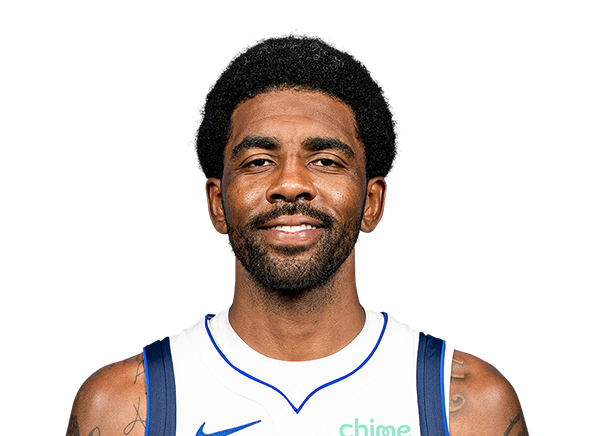
#11PG · Dallas Mavericks
Height
6'2"
Weight
195 lbs
Age
34
College
Duke
Experience
14 yrs
Wingspan
6'4.0"
Reach
8'3.0"
Hand Size
8.25" × 9.25"
Grade this player:
| Year | Team | GP | PPG | RPG | APG | SPG | BPG | FG% | 3PT% | FT% |
|---|---|---|---|---|---|---|---|---|---|---|
| Career | ![]() | 779 | 24.7 | 4.8 | 4.6 | 1.3 | 0.5 | 47.3% | 39.4% | 88.8% |
| 2024-25 | ![]() | 50 | 24.7 | 4.8 | 4.6 | 1.3 | 0.5 | 47.3% | 40.1% | 91.6% |
| 2023-24 | ![]() | 58 | 25.6 | 5.0 | 5.2 | 1.3 | 0.5 | 49.7% | 41.1% | 90.5% |
| 2022-23 | ![]() | 60 | 27.1 | 5.1 | 5.5 | 1.1 | 0.8 | 49.4% | 37.9% | 90.5% |
| 2021-22 | ![]() | 29 | 27.4 | 4.4 | 5.8 | 1.4 | 0.6 | 46.9% | 41.8% | 91.5% |
| 2020-21 | ![]() | 54 | 26.9 | 4.8 | 6.0 | 1.4 | 0.7 | 50.6% | 40.2% | 92.2% |
| 2019-20 | ![]() | 20 | 27.4 | 5.2 | 6.4 | 1.4 | 0.5 | 47.8% | 39.4% | 92.2% |
| 2018-19 | ![]() | 67 | 23.8 | 5.0 | 6.9 | 1.5 | 0.5 | 48.7% | 40.1% | 87.3% |
| 2017-18 | ![]() | 60 | 24.4 | 3.8 | 5.1 | 1.1 | 0.3 | 49.1% | 40.8% | 88.9% |
| 2016-17 | ![]() | 72 | 25.2 | 3.2 | 5.8 | 1.2 | 0.3 | 47.3% | 40.1% | 90.5% |
| 2015-16 | ![]() | 53 | 19.6 | 3.0 | 4.7 | 1.1 | 0.3 | 44.8% | 32.1% | 88.5% |
| 2014-15 | ![]() | 75 | 21.7 | 3.2 | 5.2 | 1.5 | 0.3 | 46.8% | 41.5% | 86.3% |
| 2013-14 | ![]() | 71 | 20.8 | 3.6 | 6.1 | 1.5 | 0.3 | 43.0% | 35.8% | 86.1% |
| 2012-13 | ![]() | 59 | 22.5 | 3.7 | 5.9 | 1.5 | 0.4 | 45.2% | 39.1% | 85.5% |
| 2011-12 | ![]() | 51 | 18.5 | 3.7 | 5.4 | 1.1 | 0.4 | 46.9% | 39.9% | 87.2% |
Length
3 years
Total Value
$118.5M
Guaranteed
$76.0M
AAV
$36.6M/yr
Kyrie Irving's three-year, $36.6M AAV deal with Dallas represents a classic case of elite talent commanding elite money despite significant risk factors, earning a C grade on the Contract Value Index (CVI). While Irving remains a franchise-caliber offensive weapon when healthy and engaged—hence his B+ performance grade—the Mavericks are paying him like a top-tier superstar despite his well-documented availability and chemistry concerns. At $36.6 million annually, Irving's contract sits in the upper echelon of NBA salaries, a figure typically reserved for players who can anchor a championship contender both on and off the court consistently. The disconnect between his undeniable basketball brilliance and his track record of missed games, team disruptions, and playoff inconsistencies creates a substantial gap between performance value and contract cost. Dallas essentially bet $110 million that Irving's partnership with Luka Dončić would unlock championship-level production, but the CVI suggests they're overpaying for a player whose total impact doesn't justify elite-tier compensation. This is a textbook example of talent evaluation versus contract efficiency—Irving can still ball, but the Mavericks are paying franchise cornerstone money for what amounts to a high-upside, high-risk complementary star.
Kyrie Irving earns a B+ Performance grade this season — a quality starter-level point guard putting up solid numbers for the Dallas Mavericks. He's averaging 24.7 points, 4.8 rebounds, and 4.6 assists through 779 games — carrying a significant offensive load. Kyrie's strongest area is PPG at 24.7, which compares favorably to the point guard median of 15.0. The biggest area for growth is RPG at 4.8 (point guard median: 5.0). Among 93 NBA point guards graded this season, Kyrie ranks 14th. Kyrie is a reliable contributor who the Dallas Mavericks can count on game to game.
Kyrie Irving's public standing sits at a solid A- despite a swirl of uncertainty that has defined his 2025-26 narrative in Dallas, a testament to how much residual star equity a 14-year veteran with his resume carries even when the situation around him deteriorates. The dominant media framing has shifted in a way that would be jarring for most players — Irving, once considered a centerpiece of the Mavericks' core, is now being openly discussed as a trade asset, with Cooper Flagg's emergence serving as the primary catalyst for that repositioning and multiple credible reports treating his departure as a logical, even inevitable, outcome. His B+ performance grade tells you the on-court ability hasn't abandoned him — his 2024-25 season of 24.7 PPG, 4.8 RPG, and 4.6 APG across 50 games reflects a scorer still operating at an above-average to near-elite level when healthy — but the injury that kept him out well past the All-Star break injected fresh life into durability questions that have shadowed him throughout his career. What's keeping the sentiment grade from slipping further is the public endorsement from head coach Jason Kidd, who has framed Irving as a clutch performer the franchise can still lean on, a counternarrative that carries weight even as the front office appears to be exploring its options. The Mavericks' recent roster churn — trading for Khris Middleton, Marvin Bagley III, and AJ Johnson while cutting Tyus Jones and Miles Kelly — reads less like a team building around Irving and more like an organization actively renegotiating its identity. With Dallas sitting at 26-56 on the season and the franchise clearly in the early stages of a youth movement anchored by Flagg, Irving's narrative has calcified into cautious ambivalence: the respect for his star pedigree remains genuine, but the sense that his best chapter in Dallas may already be written is impossible to ignore.
No transactions found for this player.
Auto-moderated fan forum with 5-minute speaker turns
Loading discussion...