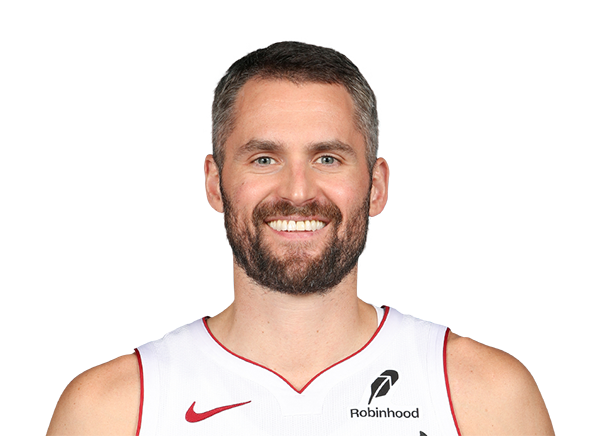
Kevin Love
#42PF · Utah Jazz
All-NBA 2nd Team '14All-NBA 2nd Team '12MIP '11All-Rookie 2nd Team '09
Iron Man
Height
6'10"
Weight
251 lbs
Age
37
College
UCLA
Experience
17 yrs
Wingspan
6'11.3"
Reach
8'10.0"
C
A-
D+
C
N/A
Fan VerdictWhat's your verdict?
Grade Kevin Love
Your grade joins the crowd-sourced Fan Verdict.
The Verdict on Kevin, in One Read
On the field, Kevin Love grades out as a shaky PF for Utah Jazz (D+ Impact). That places him 42nd of 84 graded power forwards. In his on-court role, the grade is middling (C Role), reflecting how he produces relative to others at his position. Against that production, his deal reads as fairly priced on the Contract Value Index (C) — the team is paying below what the play would command. The public read is very positive (A- Sentiment), drawn from current news and social signal rather than the box score. With 17+ seasons of track record, these grades rest on a deep sample.
Career StatsD+
| Year | Team | GP | PPG | RPG | APG | SPG | BPG | FG% | 3PT% | FT% |
|---|---|---|---|---|---|---|---|---|---|---|
| Career |  | 989 | 6.7 | 5.8 | 1.8 | 0.4 | 0.2 | 39.7% | 36.9% | 82.8% |
| 2025-26 | | 37 | 6.7 | 5.8 | 1.8 |
Performance Grade by Season
PeakA-LongevityHall of Fame WorkloadRecentD+
| Season | Team | GP | PTS | REB | AST | FG% | Grade |
|---|---|---|---|---|---|---|---|
| 2025-26 | | 37 | 6.7 | 5.8 | 1.8 | 39.7% | C- C- |
| 2024-25 |  | 23 | 5.3 | 4.1 | 1.0 | 35.7% | D D |
| 2023-24 | | 5 | 1.8 | 2.8 | 0.8 | 44.4% | F F |
| 2022-23 | | 20 | 6.8 | 5.5 | 1.2 | 37.8% | C- C- |
| 2021-22 |  | 74 | 13.6 | 7.2 | 2.2 | 43.0% | B- B- |
| 2020-21 | | 25 | 12.2 | 7.4 | 2.5 | 40.9% | C+ C+ |
| 2019-20 | | 56 | 17.6 | 9.8 | 3.2 | 45.0% | B B |
| 2018-19 | | 22 | 17.0 | 10.9 | 2.2 | 38.5% | B B |
| 2017-18 | | 21 | 14.9 | 10.2 | 1.6 | 39.2% | B B |
| 2016-17 | | 18 | 16.8 | 10.6 | 1.7 | 43.6% | A- A- |
| 2015-16 | | 20 | 14.7 | 8.8 | 2.1 | 38.5% | B B |
| 2014-15 | | 4 | 14.3 | 7.0 | 2.5 | 41.5% | B B |
| 2013-14 |  | 77 | 26.1 | 12.5 | 4.4 | 45.7% | A- A- |
| 2012-13 | | 18 | 18.3 | 14.0 | 2.3 | 35.2% | B+ B+ |
| 2011-12 | | 55 | 26.0 | 13.3 | 2.0 | 44.8% | A- A- |
| 2010-11 | | 73 | 20.2 | 15.2 | 2.5 | 47.0% | B+ B+ |
| 2009-10 | | 60 | 14.0 | 11.0 | 2.3 | 45.0% | B B |
| 2008-09 | | 81 | 11.1 | 9.1 | 1.0 | 45.9% | B- B- |
Grades reflect the player's performance in each season. Header grade shows the current season.
Current Contract
Length
1 year
Total Value
$4.2M
Guaranteed
$4.2M
AAV
$4.2M/yr
Guaranteed %100%
Contract Value Index (CVI)
C
Fair Value
OverpayFair ValueGreat Value
Production versus salary tier earns Kevin Love a C Contract Value Index in the NBA market. At $4.15M AAV on a one-year deal, Love is being paid at a veteran-minimum level—appropriate for a 37-year-old longtime veteran—yet his 2025-26 season output of 6.7 PPG, 5.8 RPG, and 1.8 APG across 37 games reflects a depth-piece contributor, not a rotation cornerstone. The CVI lands in neutral territory because there's no disconnect between what Utah is paying and what Love is delivering on the court; a modest contract for modest statistical production is a fair market value proposition. What elevates his overall standing is the profound gap between his performance grade (D+) and his sentiment grade (A-), a split rooted entirely in intangible value—his All-NBA 2nd Team credentials from 2012 and 2014 still carry weight, and media framing emphasizes his role as a locker-room stabilizer and cultural architect rather than an offensive engine in Utah's youth-evaluation phase. With only one year remaining on his deal and the Jazz actively cycling through 10-day and rest-of-season signings for young guards, Love functions as experienced ballast in a rebuild, which is precisely what a $4.15M veteran contract should provide—no overpay, no underpay, just an earned veteran presence collecting a manageable salary while the organization develops its roster around him.
Performance Analysis
D+
#42 of 84 Power Forwards
FC
Contracts in the Same Value Band
Other same-position deals the Contract Value Index also places in the C band — a quick read on where Kevin's contract sits relative to comparable money.
How Kevin Compares at the Position
Kevin Love ranks 42nd of 84 graded power forwards by performance. That slots Kevin between Keegan Murray (D+) just ahead and Jeff Green (D+) just behind.
Graded higher
Keegan MurraySacramento KingsD+Harrison BarnesSan Antonio SpursD+Joan BeringerMinnesota TimberwolvesD+Kevin LoveD+
Graded lower
Jeff GreenHouston RocketsTransaction History
No transactions found for this player.
News & Buzz
Live Discussion
Auto-moderated fan forum with 5-minute speaker turns
Discussion
Loading discussion...
Explore the leaderboards
About this player
Kevin Love is a veteran in his 17th NBA season listed at PF for the Utah Jazz. FanVerdicts covers every NBA player, team, GM, and transaction — and puts your verdict on all of it. Sign in to cast your Fan Verdict on Kevin Love, see where the crowd lands, and argue the call. FanVerdicts also brings its own read — performance, sentiment, and Contract Value Index — as one honest input alongside the crowd's. Where FanVerdicts has weighed in so far: Contract Value Index C, Performance D+, Sentiment A-.
The crowd's Fan Verdict moves in real time as fans vote on this profile. FanVerdicts' own read updates as new data lands — performance recalculates when NBA game stats post, sentiment shifts with media coverage and fan discussion, and the Contract Value Index recomputes when contract terms change. Contract details below show the structure (years, total value, average annual value, guarantees) behind the Contract Value Index read.
For league-wide context, the NBA hub has team rankings, GM report cards, the transactions feed, and live scoreboards. The NBA player rankings page sorts every active player by performance and contract value within their position.