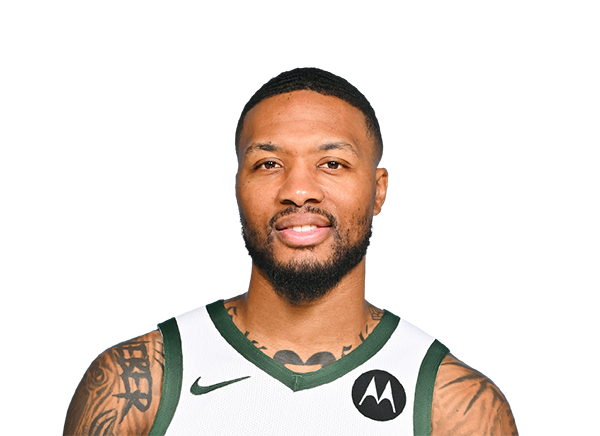
#0PG · Portland Trail Blazers
Height
6'2"
Weight
200 lbs
Age
35
College
Weber State
Experience
13 yrs
Wingspan
6'7.8"
Reach
7'11.5"
Hand Size
8.75" × 9.75"
Grade this player:
| Year | Team | GP | PPG | RPG | APG | SPG | BPG | FG% | 3PT% | FT% |
|---|---|---|---|---|---|---|---|---|---|---|
| Career | ![]() | 900 | 7.0 | 2.7 | 4.7 | 0.7 | 0.7 | 22.2% | 37.1% | 89.9% |
| 2024-25 | ![]() | 3 | 7.0 | 2.7 | 4.7 | 0.7 | 0.7 | 22.2% | 18.8% | 85.7% |
| 2023-24 | ![]() | 4 | 31.3 | 3.3 | 5.0 | 1.0 | 0.0 | 42.0% | 41.7% | 97.4% |
| 2022-23 | ![]() | 58 | 32.2 | 4.8 | 7.3 | 0.9 | 0.3 | 46.3% | 37.1% | 91.4% |
| 2021-22 | ![]() | 29 | 24.0 | 4.1 | 7.3 | 0.6 | 0.4 | 40.2% | 32.4% | 87.8% |
| 2020-21 | ![]() | 6 | 34.3 | 4.3 | 10.2 | 1.0 | 0.7 | 46.3% | 44.9% | 94.0% |
| 2019-20 | ![]() | 4 | 24.3 | 3.5 | 4.3 | 0.5 | 0.3 | 40.6% | 39.4% | 97.0% |
| 2018-19 | ![]() | 16 | 26.9 | 4.8 | 6.6 | 1.7 | 0.3 | 41.8% | 37.3% | 83.3% |
| 2017-18 | ![]() | 4 | 18.5 | 4.5 | 4.8 | 1.3 | 0.0 | 35.2% | 30.0% | 88.2% |
| 2016-17 | ![]() | 4 | 27.8 | 4.5 | 3.3 | 1.3 | 0.5 | 43.3% | 28.1% | 96.0% |
| 2015-16 | ![]() | 11 | 26.5 | 4.3 | 6.3 | 1.3 | 0.3 | 36.8% | 39.3% | 91.0% |
| 2014-15 | ![]() | 5 | 21.6 | 4.0 | 4.6 | 0.4 | 0.6 | 40.6% | 16.1% | 78.1% |
| 2013-14 | ![]() | 11 | 22.9 | 5.1 | 6.5 | 1.0 | 0.1 | 43.9% | 38.6% | 89.4% |
| 2012-13 | ![]() | 82 | 19.0 | 3.1 | 6.5 | 0.9 | 0.2 | 42.9% | 36.8% | 84.4% |
Length
5 years
Total Value
$154.2M
Guaranteed
$27.5M
AAV
$36.6M/yr
Damian Lillard's five-year, $36.6M AAV extension with Portland represents one of the most concerning contract values in the NBA, earning a failing Contract Value Index (CVI) grade that reflects a dramatic misalignment between compensation and current production. While Lillard remains a recognizable name and capable scorer, his C+ performance grade exposes significant decline from his elite years, particularly in efficiency metrics and defensive impact that fail to justify franchise-player money. The Trail Blazers are essentially paying for past reputation rather than present value, as Lillard's advanced metrics suggest he's operating closer to an above-average starter level while commanding compensation reserved for elite, franchise-caliber talent. This contract becomes even more problematic when considering the length and lack of team-friendly options, effectively handcuffing Portland's salary cap flexibility during what should be crucial roster-building years. The combination of declining performance trends, age-related concerns, and the sheer magnitude of the financial commitment creates a textbook example of why teams must resist overpaying for name recognition over actual production. Portland's front office appears to have prioritized loyalty and marketability over sound financial stewardship, resulting in one of the league's most underwater contracts that will likely hamper their competitive ceiling for years to come.
Damian Lillard earns a C+ Performance grade, reflecting league-average production for a point guard. Through 900 games, Damian is contributing 7.0 points, 2.7 rebounds, and 4.7 assists per game in his role. Damian's strongest area is APG at 4.7, which compares favorably to the point guard median of 4.0. The biggest area for growth is PPG at 7.0 (point guard median: 15.0). Among 93 NBA point guards graded this season, Damian ranks 37th.
Damian Lillard's public standing is as strong as it has been in years, riding a wave of goodwill that is genuinely striking given how complicated his situation in Portland has become. The career resume does most of the heavy lifting here — a 2018 All-NBA First Team selection, multiple All-NBA Second Team nods across his prime years, a 2024 All-Star MVP, and a career scoring average north of 25 points per game paint the portrait of a franchise-caliber guard whose legend is largely cemented in the minds of fans and most analysts. The disconnect, however, is real: that sterling reputation is running well ahead of his current on-court production, with the 2024-25 season showing just 7.0 PPG, 2.7 RPG, and 4.7 APG across only three games — a stark reminder that his body has not allowed him to make the case for himself this season. The narrative headwinds are notable: his public declaration that he will not suit up for a team with no realistic playoff path has raised pointed questions about his commitment to the franchise, a former player's challenge to his Hall of Fame credentials generated legitimate media chatter, and Portland's roster activity — fringe signings and low-profile extensions — does little to signal the organization is building toward anything that would meet his stated threshold. With the Blazers sitting at 42-40 as the No. 7 seed in the West and reports surfacing that the franchise is open-minded about a potential Lillard return during these playoffs, the narrative has pivoted sharply from uncertainty to cautious optimism, which explains why sentiment has trended all the way up to an A despite the performance-grade reality. The bottom line: Lillard's reputation as one of the great guards of his generation is insulating him from a messier story underneath, and right now, the public is betting on the icon — not the injury log.
Auto-moderated fan forum with 5-minute speaker turns
Loading discussion...